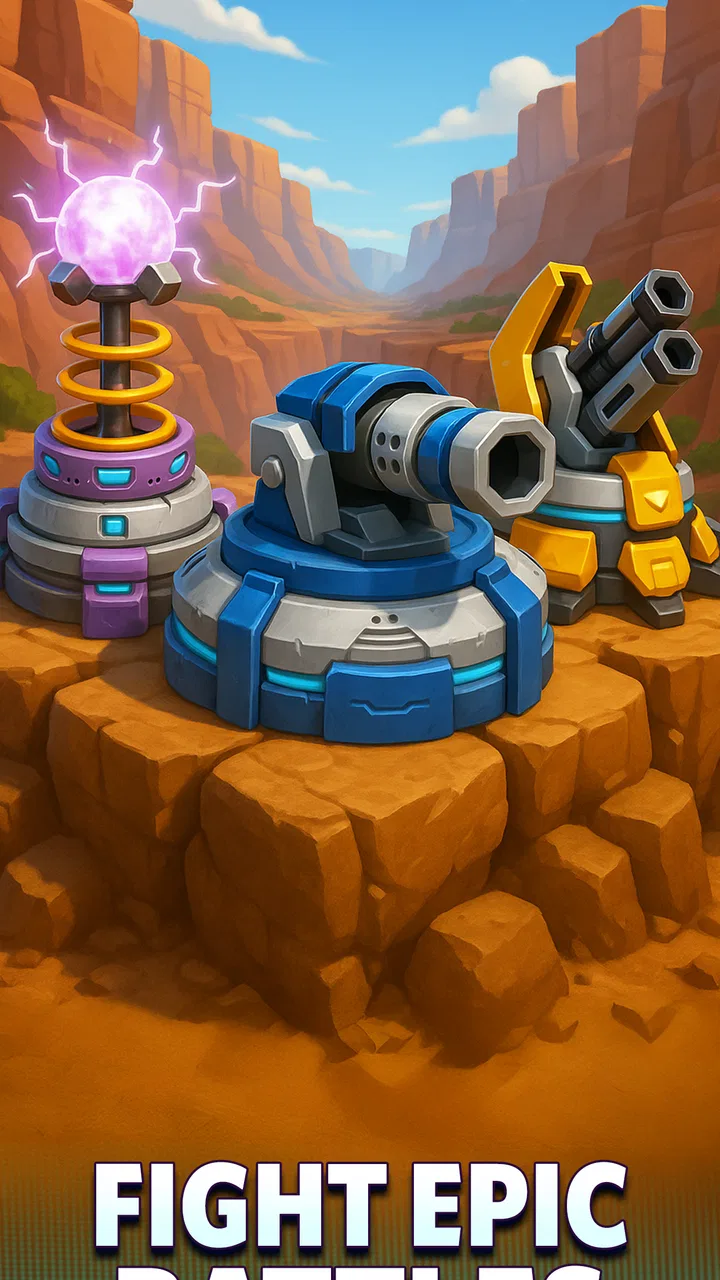
Raid Rush: Tower Defense TD
- 4.0
- Rating
- 5.00M
- Installs
- Free
- Price

 Analysis by App-foxy
I went into Raid Rush: Tower Defense TD expecting a quick strategy game and found something that sits comfortably between a casual time-killer and a more demanding tower defense challenge. It is free to play, made by Panteon, and built around defending against enemy attacks through tactical battles and chapter-based progression. The basic idea is easy to understand, but the decisions become less obvious once a familiar placement stops working.
That balance is the main reason I kept returning to it. I can play a short session when I have a few spare minutes, yet the game still gives me something to think about when a level starts pushing back. It is not a passive game where I can place a few defenses and ignore the screen. I need to watch what is happening, decide where my resources matter most, and accept that an apparently strong setup may fail when the pressure changes.
What playing Raid Rush feels like in practice
The strongest part of the experience is the relationship between preparation and reaction. A tower defense game can become dull when one arrangement solves every stage, but Raid Rush encourages me to reconsider the layout and timing whenever a wave exposes a weakness. The store summary calls it an epic tower defense strategy game, but my experience is more grounded: its appeal comes from repeated small decisions rather than from one grand strategic system.
You May Also Like

 Blood Strike: 2.5 Anniversary
Blood Strike’s Loadouts Turn Every Drop Into a Tactical Gamble
A close look at Blood Strike’s custom loadouts: how fast access to signature weapons reshapes its battle royale rhythm, rewards preparation, and narrows the gap between fights.

 Pandora - Music & Podcasts
Pandora’s Music Is Easy to Start, but Harder to Recover
Pandora’s strength is its low-effort path from a seed to a station. Its weak spot is how much confidence it asks you to place in connection, setup, and quiet recovery.

 8 Ball Pool
 Is Built on Rivalries, Rematches, and Routine
A close look at the rivalries, rematches, shared routines, and unanswered safety questions that turn a quick pool match into a persistent mobile community.

 Samsung Music
’s Quiet Strength Is Playing What You Already Own
Its reach comes less from spectacle than from dependable access to a personal library. That simplicity is both the app’s strongest retention engine and its ceiling.

 AccuWeather: Weather Radar
AccuWeather Review: A Quick, Clear Forecast for Everyday Decisions
For everyday plans, the best forecast is the one you can understand quickly. AccuWeather makes rain timing, radar, and local conditions easy to act on, with a few trade-offs.

 Hill Climb Racing
Why Hill Climb Racing Still Turns Crashes Into One More Run
A tiny car, a bumpy hill and one more upgrade: Hill Climb Racing keeps resurfacing because its simple chaos makes every near-miss feel personal.
More From Our News Desk



The chapter structure helps give those decisions a sense of direction. Instead of feeling like an endless collection of disconnected battles, progression gives me a reason to try again after a failed attempt. I usually learn more from losing than from winning quickly, because a defeat shows whether I spent too much attention on one route, reacted too late, or relied too heavily on a defense that was not suited to the situation.
That learning curve also explains why the game may feel different depending on the player. Someone looking for a completely relaxed experience may find the later tactical pressure inconvenient. Someone who enjoys adjusting a plan, testing a different arrangement, and improving through repetition will probably get more from it. I would describe it as accessible at the start, but not automatically easy just because the controls and objective are straightforward.
Where new players tend to get stuck
The first common mistake is treating every battle as a placement puzzle only. I initially focused too much on where defenses should go and not enough on how the whole route behaved once enemies started moving. A strong position can still underperform if the rest of the setup leaves a different section exposed. Looking at the full path before committing is more useful than immediately copying the first arrangement that appears to work.
A second trap is changing too many things after a failed attempt. If I move every defense, alter every choice, and restart immediately, I do not know what actually fixed the problem. A better method is to identify the first point where the defense loses control, then adjust one part of the setup. This turns retries into experiments instead of frustration.
Players can also get stuck by assuming that a previous victory proves the same approach will remain reliable. Tower defense games often punish that habit, and Raid Rush is more enjoyable when I treat each new challenge as a prompt to reassess rather than as a routine repetition. If a wave reaches the end unexpectedly, I look at the earliest moment when the pressure became unmanageable instead of blaming the final few seconds.
One practical tip is to pause mentally between attempts, even if the session itself is short. I ask myself three questions: where did the first leak begin, which defense was doing the least useful work, and whether I was reacting to the visible threat while ignoring another route. Those questions are more valuable than simply trying the same layout with faster taps.
Setup checks before blaming the game
Raid Rush supports devices running Android 7.0 or later, so compatibility is the first sensible check for Android users. A supported operating system does not automatically guarantee a perfect experience on every device, though. Before judging a problem as a game fault, I would close other demanding apps, restart the device, and make sure the game has had a clean launch.
Because it is free with optional in-app purchases, I also recommend deciding in advance how you want to play. The available purchase range runs from $0.49 to $99.99 per item, which is a wide enough spread that a player should not make an impulse decision simply because a difficult stage feels irritating. I found the better approach is to treat purchases as optional convenience rather than as part of the basic learning process.
Another useful setup check is session length. If I begin a battle while distracted, switching between messages and the game, I am more likely to miss the moment when the defense starts failing. That can look like an unfair difficulty spike when the real issue is divided attention. For short sessions, I prefer playing when I can watch the route continuously, even if I only have time for one attempt.
On a touch screen, accidental taps can also make a strategy game feel less precise than it is. I get better results when I hold the device steadily and avoid trying to make several changes at once. This sounds simple, but it matters in a game where a rushed adjustment can leave a critical position unattended.
Recovering after a failed run
My recovery routine is deliberately conservative. First, I replay the stage without changing anything, purely to observe the timing of the failure. Then I make one meaningful adjustment and watch whether the problem moves, disappears, or returns in another form. This approach is slower than random experimentation, but it makes progress easier to understand.
If the problem is an overwhelmed route, I prioritize coverage over appearance. A defense that looks powerful in isolation is not useful if the enemies can bypass its effective area. I also avoid spending every available option immediately. Keeping some flexibility gives me a chance to respond when the battle develops differently from the opening moments.
When a retry works, I do not assume the result is permanent. I test the same idea once more to see whether it was a genuine improvement or simply a favorable sequence. That extra check is especially helpful for players who want a repeatable method rather than a lucky clear. It also reduces the feeling that progression depends entirely on guessing.
For a player returning after a break, I would not jump straight into the hardest available challenge. I would replay a familiar stage first and use it to rebuild the rhythm of observing, placing, and reacting. This makes the return less tiring and helps separate forgotten controls from genuinely difficult strategy.
When the app may not be the cause
Not every interruption or poor result comes from Raid Rush itself. A device that is nearly full, running hot, or busy with background activity can make any game feel unstable. If the game becomes sluggish only after a long session, I would stop, let the device cool, close other apps, and try again later rather than immediately reinstalling it.
Network-related interruptions can also be confused with gameplay difficulty. If something behaves differently from one session to the next, I check whether the connection is stable before rebuilding my entire strategy. A failed battle that results from a temporary interruption should not be used as evidence that the layout is wrong.
Reinstallation is a more serious step than many players treat it. I would use it only after basic restarts and device checks, and only after considering whether current progress or account-related information is safely retained. The sensible principle is simple: do not erase a game as a first reaction to a single bad session.
There is also a human cause worth mentioning. If I have been retrying the same stage for too long, my decisions become rushed and I start making changes without observing the result. Taking a short break often helps more than another immediate attempt. Tower defense rewards attention, and fatigue can imitate poor balancing.
How it compares with other tower defense choices
Compared with very casual defense games, Raid Rush asks more from me than simply tapping through a familiar pattern. Its tactical emphasis makes it a better fit for players who want their placement choices to matter. The trade-off is that it is less suitable when I want a completely passive game that can run in the background.
Compared with large, highly complex strategy games, it is easier to approach. I do not need to learn a huge number of systems before understanding the immediate objective. That makes it a practical choice for someone who likes strategy but does not want a long tutorial or a massive commitment before the first meaningful decision.
It is also different from a puzzle game in one important way: the solution is not only about finding a correct arrangement. Timing, observation, and recovery matter too. If I prefer fixed logic puzzles with one clean answer, this may feel less tidy. If I enjoy adapting a plan while events unfold, the real-time pressure is an advantage.
The free entry point makes it easy to test without paying first. Still, the presence of optional purchases means players who are sensitive to spending prompts should establish their own boundaries before playing. For me, the game works best when I judge progress by improved decisions, not by whether money can remove a difficult moment.
Who will enjoy it, and who should skip it
I would recommend Raid Rush to someone who enjoys short strategy sessions, especially if that person likes learning from failed attempts. It suits a commute, a waiting room, or a quiet break at home when I want something more engaging than a simple reflex game. A realistic session might be one or two attempts at a stage, followed by a quick review of where the defense broke down.
It is also a good fit for players who appreciate gradual mastery. The satisfaction is not only in clearing a chapter; it is in noticing that a small change produces a cleaner result. The game gives that kind of feedback naturally because an altered setup can change where pressure accumulates.
I would skip it if I wanted a story-first game, a completely hands-off experience, or a strategy title with no possibility of spending prompts. I would also look elsewhere if I disliked retrying stages. Repetition is part of the appeal here, but it can feel like a chore to anyone who expects steady progress without revisiting earlier decisions.
Families should note that the content rating is Everyone, which makes the game broadly accessible from an age perspective. That does not mean every child will find the strategic pressure enjoyable, and younger players may still need guidance around optional purchases. The game is more about planning and attention than about fast reactions, so interest matters more than age alone.
What the current release means for choosing it
The game was released on December 16, 2022, and its current version is 1.467. Those details matter mainly because they identify the version a player is likely to encounter when deciding whether the experience feels current enough for their device. Panteon has positioned it as an ongoing mobile game rather than a one-off offline puzzle, so I approach it with the expectation that the experience may evolve over time.
Its audience is already substantial: the game has passed five million installs, with an average rating of 4.2 from around 189 thousand ratings and roughly 3.9 thousand written reviews. I would not treat popularity as proof that every player will enjoy it, but it does suggest that the basic tower defense loop has connected with a broad mobile audience.
The important thing is to read that reception alongside the actual play style. A strong average rating cannot remove the personal trade-offs: retries may be demanding, optional purchases may not appeal to everyone, and the need to pay attention can make it unsuitable for background play. I prefer that kind of realistic expectation to installing it simply because the numbers look reassuring.
My practical verdict
After spending time with it, I see Raid Rush as a focused strategy game that earns its place through readable decisions and a useful retry loop. It does not need to overwhelm me with complicated systems to make a stage interesting. The key is whether I am willing to observe the route, change one part of a plan, and try again with a clearer idea of what went wrong.
My best advice is to begin without spending, learn how the battles respond to your choices, and use failures as information. Keep sessions short when attention is limited, check the device before assuming a technical problem, and avoid rebuilding the entire setup after every defeat. Those habits make the experience calmer and reveal more of the strategy.
For me, the game is worth trying because it offers more thought than a disposable time-killer while remaining easier to enter than a heavyweight strategy title. Its biggest strength is the practical loop of observe, adjust, and retry. Its biggest limitation is that this same loop will not suit players who want effortless progress. If that trade-off sounds appealing, the free download makes Raid Rush a low-risk way to find out whether its tactical rhythm matches your taste.
In the end, I would recommend it to a friend who likes tower defense but wants each attempt to teach something. I would not recommend it to someone looking for a purely relaxing background game. That distinction is important, and it is why my opinion is positive without being universal: Raid Rush is most enjoyable when I give it enough attention to let its small strategic choices matter.
FAQs for Raid Rush: Tower Defense TD
01What is the main objective of Raid Rush: Tower Defense TD?
Raid Rush: Tower Defense TD is a strategic game where your primary goal is to defend your territory against waves of enemy attacks. Players must strategically place towers and upgrade them to fend off increasingly challenging adversaries. Each level presents unique challenges and requires quick thinking and planning to succeed.
02Is Raid Rush: Tower Defense TD suitable for all age groups?
While Raid Rush: Tower Defense TD is designed to be family-friendly, it’s best suited for players aged 10 and above due to its strategic elements and gameplay complexity. Younger players might find the strategic planning aspect challenging, but it’s a great game for older kids and adults looking for a tactical challenge.
03Does Raid Rush: Tower Defense TD require an internet connection?
The game can be played offline, allowing you to enjoy it without an internet connection. However, certain features, such as in-game purchases and leaderboard updates, require an internet connection. Playing online may also provide access to special events and updates.
04Are there in-app purchases in Raid Rush: Tower Defense TD?
Yes, Raid Rush: Tower Defense TD offers in-app purchases. Players can buy in-game currency, special weapons, and upgrades to enhance their gameplay experience. While these purchases can provide advantages, the game is designed to be enjoyable without spending money, though progression might be slower.
05How frequently does Raid Rush: Tower Defense TD receive updates?
The developers regularly update Raid Rush: Tower Defense TD to introduce new levels, towers, and features. Updates also include bug fixes and improvements based on player feedback. It’s recommended to keep the app updated to enjoy the latest content and enhancements.
Pros
- Engaging gameplay with strategic depth.
- Visually appealing with vibrant graphics.
- Frequent updates with new levels and challenges.
- Intuitive controls for smooth gameplay.
- Active community for player support and tips.
Cons
- Ads can be intrusive during gameplay.
- In-app purchases can be pricey.
- Occasional lag on older devices.
- Limited offline mode functionality.
- Some levels can feel repetitive.

Raid Rush: Tower Defense TD
Gallery